Fragile Citizens
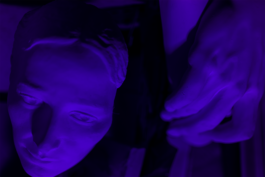
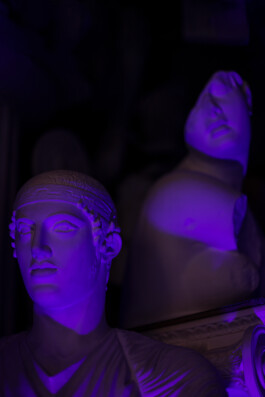
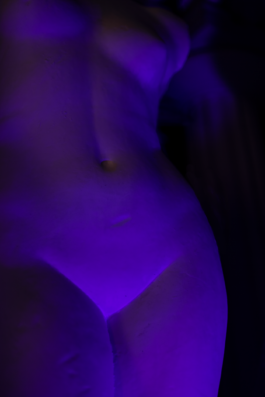
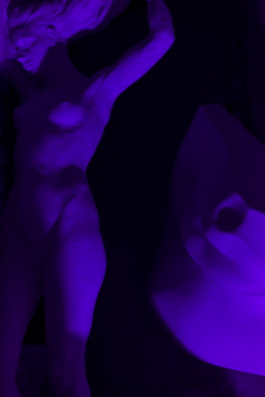
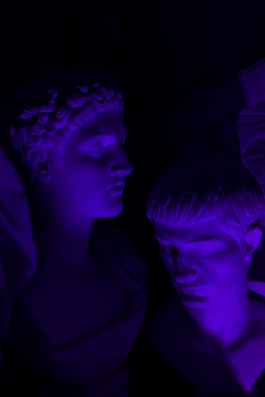
Fragile Citizens is a series of photographs to a reproductions of classical sculptures illuminated by an ultraviolet light usually utilized in archaeology and restoration to make visible the imperfections or the presence of non-original materials. The plaster copies in the gypsoteca, in their evident fragility, seem apparently ‘perfect’ under ultraviolet light, according to its conventional use. The term ‘perfection’ has as synonyms, among many completeness and exemplarity, inimitable. The contrast between the nature of these figures, which lies in their reproduction in duplicates, and the concept of perfection remains suspended around what is meant by value: value is perfection? or can we understand fragility, a constituted element of the present, as a virtue, a value, which resolves itself in change?
The change occurs when, for some reason, we find ourselves in a riskier condition, in which we are weaker, more fragile. If we operate exclusively according to the logic realization, of completeness, of excellence and usefulness, of ‘perfection’, we will lose access to all those ways of making sense that hold against unpredictability, instability and vulnerability, according to which we react and create relationships: “(…) the unpredictable nature of time is frightening, but thinking through precariousness also highlights that indeterminacy makes life possible” (from The Mushroom at the End of the World. On the Possibility of Life in Capitalist Ruins, by Anna Lowenhaupt Tsing).
Thanks to Gipsoteca Mondazzi.
Direct Uv led prints on 5mm float glass, color.
84×56 cm., 72×48 cm., 63×42 cm.
2022

Selected projects
Silvia Margaria (Savigliano, 1985) lives and works in Turin.
After studying at the Accademia Albertina di Belle Arti in Turin, she spent a few years at the film archive of the Museo Nazionale del Cinema in Turin, working in the film inspection and cataloguing department. This experience profoundly shaped her artistic research, fostering a methodology based on observation, waiting, deceleration and discovery, as well as a conscious attention to the dynamics of preservation and disappearance.
Her practice unfolds through photography, installation, video, archival research and site-specific projects. Through dialogue with visual traces, memories and landscapes, her work investigates the relationships between memory and oblivion, fragility and permanence, human and non-human environments. Her research pays particular attention to contingencies, fragments, latent narratives and the coexistence of opposing forces.
She has been a member of Progetto Diogene and she is co-founder of Progetti Specifici, an independent association dedicated to contemporary art research. She has also worked as tutor and coordinator for artistic residency and research programs, including Casa Walser, Hòbelté (2021) and The Unseen, Progetto Diogene (2017–2019). In 2025, she is one of the founders of Emulsioni, a festival of analogue photography held in Ferrania (SV), on the site of the former film factory.
“Friction, between a nature that reveals itself and at the same time retreats into its most essential part, is the very secret of nature, namely the invisible reason of which the world is its external manifestation. Silvia Margaria’s poetic vision straddles this very point: the artist seeks the imperceptible part of nature and explores its process of appearing with an observational work based on the desire to understand the mystery of life as it runs its course. Her work, in line with what it explores, is configured in the ambiguity of opposites (scattering/concentration – hiding/revealing – searching/finding – one/many – solitude/collectivity – communication/relationship – remembrance/oblivion – resistance/change) in relation to each other rather than in their divergent reciprocation, through the processing of the transitive quality of concepts, so that the consequential motion that characterises the natural flux of things can be drawn from their dialogic link.”
(Alice Zannoni, curator of the personal exhibition “La natura (non) ama nascondersi”, Cubo – spazio arte, Bologna, 2021).