Go / No-Go
(Garden Test)
“Il mondo non è il prodotto di soggettività umane che impongono significati, ma un campo in cui umano e non umano co-producono realtà.”
Sara Benaglia, “Immagini infestate. Ecologie tossiche della fotografia.”
Mimesis edizioni, 2026
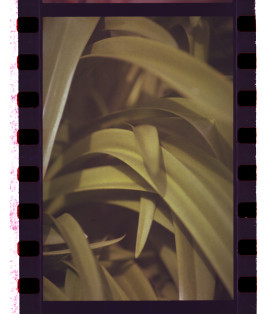
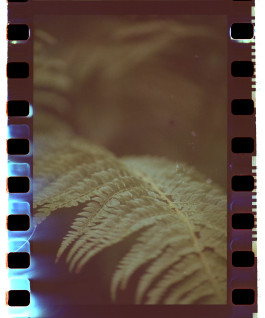
The project unfolds as an experimental process that brings photography, the environment and unpredictability into dialogue. A number of rolls of film were left for some time in an outdoor space: exposed to environmental conditions, the passage of time and the transformations of the site; the photosensitive material undergoes a phase of latency and alteration, accumulating traces, deterioration and changes that are neither fully predictable nor controllable. In this initial state of suspension, the roll of film functions as a device undergoing a silent test, a threshold of uncertain operation – a condition that the project encapsulates in the title Go / No-Go, evoking the control protocols typical of industrial and photographic processes. The films, subsequently used to take photographs in the very same space that housed them, reveal – once developed – what the environment has imprinted on the frames, establishing a connection between human intention and the unpredictable forces of the context.
The resulting images arise from the interplay between gesture, time, material and environment. Traces, smudges and distortions are not seen as errors, but as signs of a process: evidence of transformations that become part of the visual language. The context thus emerges not as a subject to be documented, but as a field of forces, an active site of transformation and co-authorship.
Fine Art photographic prints on Hahnemühle Photo Rag Book&Album 200 paper from colour film, variable dimensions
2026
The project was produced during the Innesti artist residency at Il Giardino di Yoshimasa (Ceranesi, GE).






Selected projects
Silvia Margaria (Savigliano, 1985) lives and works in Turin.
After studying at the Accademia Albertina di Belle Arti in Turin, she spent a few years at the film archive of the Museo Nazionale del Cinema in Turin, working in the film inspection and cataloguing department. This experience profoundly shaped her artistic research, fostering a methodology based on observation, waiting, deceleration and discovery, as well as a conscious attention to the dynamics of preservation and disappearance.
Her practice unfolds through photography, installation, video, archival research and site-specific projects. Through dialogue with visual traces, memories and landscapes, her work investigates the relationships between memory and oblivion, fragility and permanence, human and non-human environments. Her research pays particular attention to contingencies, fragments, latent narratives and the coexistence of opposing forces.
She has been a member of Progetto Diogene and she is co-founder of Progetti Specifici, an independent association dedicated to contemporary art research. She has also worked as tutor and coordinator for artistic residency and research programs, including Casa Walser, Hòbelté (2021) and The Unseen, Progetto Diogene (2017–2019). In 2025, she is one of the founders of Emulsioni, a festival of analogue photography held in Ferrania (SV), on the site of the former film factory.
“Friction, between a nature that reveals itself and at the same time retreats into its most essential part, is the very secret of nature, namely the invisible reason of which the world is its external manifestation. Silvia Margaria’s poetic vision straddles this very point: the artist seeks the imperceptible part of nature and explores its process of appearing with an observational work based on the desire to understand the mystery of life as it runs its course. Her work, in line with what it explores, is configured in the ambiguity of opposites (scattering/concentration – hiding/revealing – searching/finding – one/many – solitude/collectivity – communication/relationship – remembrance/oblivion – resistance/change) in relation to each other rather than in their divergent reciprocation, through the processing of the transitive quality of concepts, so that the consequential motion that characterises the natural flux of things can be drawn from their dialogic link.”
(Alice Zannoni, curator of the personal exhibition “La natura (non) ama nascondersi”, Cubo – spazio arte, Bologna, 2021).